
NYT Spelling Bee Hints Today
Get structured spelling bee hints for today, that will help you solve the New York Times Spelling Bee puzzle without revealing the full answers. Use letter distributions, word-length breakdowns, pangram hint, and prefix patterns to guide your progress.
 NYT Spelling Bee Hints
Get Daily Answers by Email
We send the complete answer list to your inbox as soon as each puzzle is published. No spam, ever.
Choose your hint level
- Basics
- First Letters
- Word Lengths
- Pangrams
- Two Letters
- Three Letters
- Full Grid
- Meanings
Level 1 unlocked: the basics
Letters, counts and score shape are on the board. Pick another level whenever you want a deeper look.
Level 1
Puzzle Overview
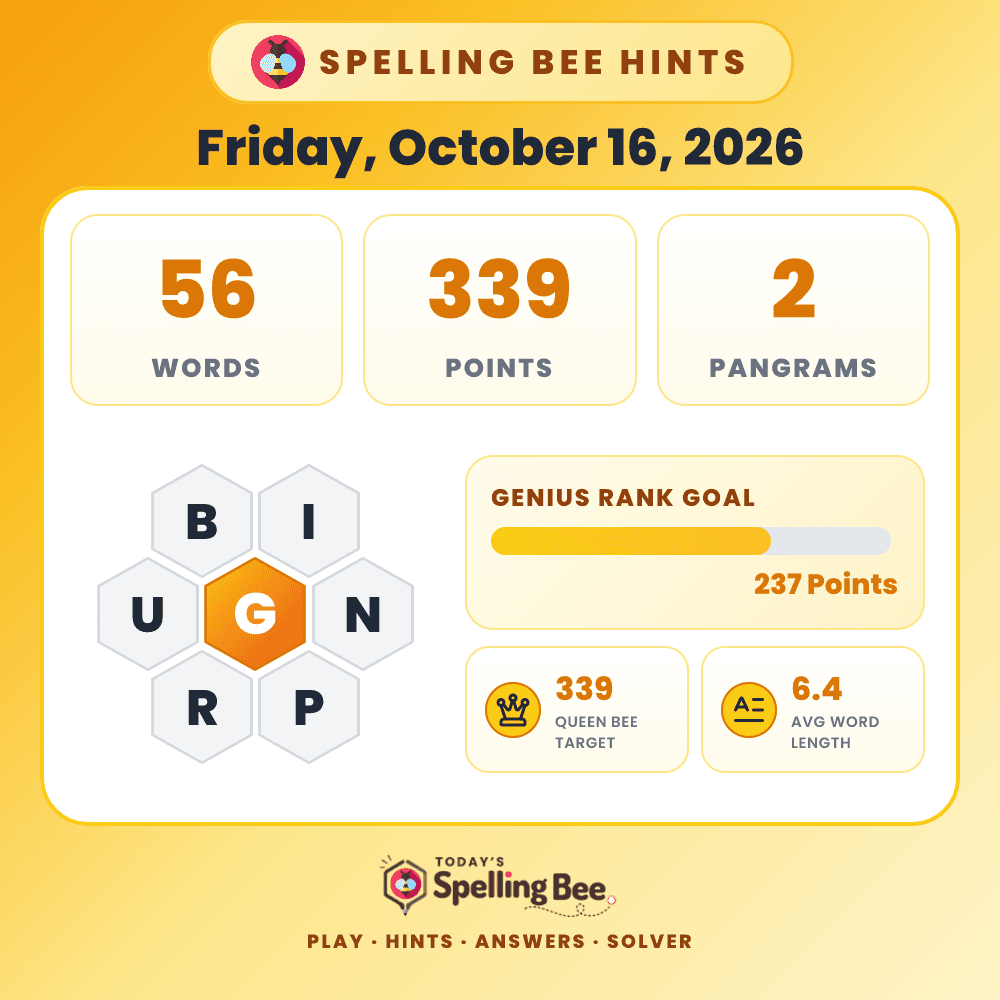
The shape of the Friday, October 16, 2026 hive at a glance.
Share of answers that contain each letter.
Browse past puzzle hints
Pick an amber tile to load the spelling bee hints. The center letter is highlighted in amber.
How to use the spelling bee hints
Start at Level 1 and stop the moment you can solve on your own again. The two-letter tally usually does the job: compare each pair with the words you already found, and any shortfall points at a blind spot. Save the letter grid for the long words you keep missing, and treat definitions as a last resort since they hand you more than a nudge.
From this hive (October 16, 2026): GR opens 7 words, more than any other two-letter start. Found fewer than that in the G column and you still have a gap in that corner of the board.
Know what the points are doing: four-letter words earn 1 each, longer words earn their length, and anything touching all seven letters picks up the +7 bonus. Genius lands at 237 points on this board, 70% of the 339 available, and the 2 pangrams are worth 31 of them. Every word uses G, so start your hunts there.
Still stuck? Open the full answers, browse the pangram list, or feed the letters into the solver for a custom hive.
Suggested order
- 1Run a clean first pass and see how far the hive takes you.
- 2Level 2 shows which starting letters carry the word count.
- 3Level 5 tallies every two-letter opening to close exact gaps.
- 4Level 7 maps letters against lengths when long words are missing.
- 5Level 4 breaks the pangrams down when the big points matter.
- 6Level 8 definitions are the last stop before the full answers.
Got Questions?
What are NYT Spelling Bee hints?
NYT Spelling Bee hints are spoiler-free clues that help you solve the puzzle without revealing the full answer list. They guide you using letter patterns, word lengths, and score distributions.
How are these hints different from Spelling Bee answers?
Hints focus on patterns and distributions, not solutions. They help you discover words on your own, while answers reveal the complete word list and pangrams.
Do these hints spoil today’s NYT Spelling Bee puzzle?
No. The hints are designed to avoid showing specific words or full answers unless you intentionally switch to the answers section.
What kind of hints are provided?
Hint includes rank score targets, letter and length distributions, starting-letter counts, and two- and three-letter prefix insights for today’s puzzle.
Can I use these hints to reach Genius or Queen Bee?
Yes. The score thresholds and distribution charts help you understand how many points or words you still need to reach higher ranks like Genius or Queen Bee.
Are these hints for the official New York Times Spelling Bee?
Yes, these hints are for the official NYT Spelling Bee puzzle for the selected date, but this site is independent and not affiliated with The New York Times.
Do I need an account to use NYT Spelling Bee hints?
No. All hints are available for free and can be used directly in your browser without signing up or logging in.
Can I view hints for past Spelling Bee puzzles?
Yes. You can browse hints for previous dates to study word patterns and improve your long-term solving strategy.
Are hints better for learning than using a solver?
Many players prefer hints because they preserve the challenge. Hints support learning and discovery, while solvers and answers are better suited for validation or review.